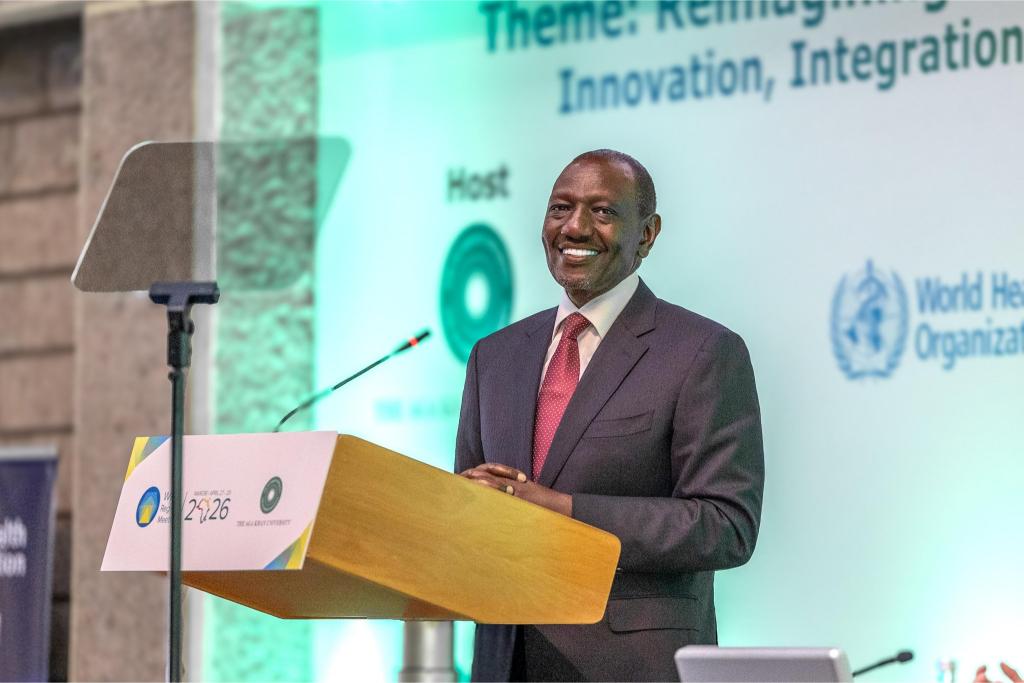
President Ruto has urged African leaders to take ownership of health financing and reforms, warning that donor dependency and fragmented systems are weakening resilience.
He called for stronger policy leadership, digital integration and local manufacturing, saying Africa must become a producer of solutions rather than a consumer.
Speaking on Monday during the World Health Summit Regional Meeting in Nairobi, the President said Africa is no longer a passive participant in global health but an active player in shaping its future direction.
Latest Stories
- KURA reports progress on diversity and inclusion in workforce
- Mohit claims victory in opening leg of PGK Equator Golf Tour
- Suspect in viral hate speech video detained for 10 days to allow probe
- Iran blames US demands for failed Islamabad peace talks
- Tribunal freezes FKF ouster of Hussein Mohamed over Sh42m CHAN funds
“This summit is convened on African soil for the third time and it is an acknowledgement that the future of health policy, innovation and delivery cannot be meaningfully advanced without Africa at the front and center,” he said.
Nairobi is hosting the World Health Summit Regional Meeting from Monday, April 27 to 29, marking the first time the high-level global health forum is being held in Kenya.
Convened at the United Nations Office at Nairobi, the meeting has brought together health leaders, policymakers, researchers, donors and private sector players from more than 50 countries to discuss Africa’s health priorities.
It is being held in Nairobi because of Kenya’s growing role in health diplomacy, research and innovation, and its position as home to major UN agencies and regional institutions.
It is hosted by Aga Khan University in partnership with the World Health Organization, Kenya’s Ministry of Health and Africa Centres for Disease Control and Prevention.
Held under the theme “Reimagining Africa’s Health Systems,” the summit seeks solutions on universal health coverage, financing, local pharmaceutical production, digital health, climate resilience and pandemic preparedness.
Leaders are expected to end the talks with policy commitments, partnerships and investment plans aimed at strengthening resilient African health systems.
The President said Africa faces deep structural challenges, including heavy disease burdens, limited domestic financing and overdependence on imported medical supplies.
“Africa today carries more than 25% of the global disease burden, yet accounts for less than 3% of global health expenditure,” he said, adding that the continent produces “less than 2% of what we consume” in medicines and vaccines.
President Ruto warned that these imbalances are “neither sustainable nor tenable”, calling for a shift from fragmented interventions to system-wide reform supported by stronger governance and financing models.
At the same time, he said Africa has significant opportunities, including a young population, expanding digital infrastructure and growing innovation capacity, which should be harnessed to position the continent as a producer of solutions.
“Our responsibility is not merely to recognize Africa’s potential, but to fully realize it through coordinated investment and policy alignment,” he said.
The President highlighted Kenya’s ongoing health reforms as an example of this shift, saying the country now views health as an investment rather than a cost.
“In Kenya, we have sought to translate this vision into action by undertaking a comprehensive reform programme,” he said.
He pointed to the Social Health Authority (SHA), which he said has expanded insurance coverage significantly since its launch in October 2024.
“Nearly 30.7 million Kenyans have registered as members of SHA,” he said, adding that insurance coverage had increased nearly fourfold from 8 million people two years earlier.
The President also said Kenya had collected about Sh169 billion (approximately 1.3 billion US dollars) in health funds and paid out 124 billion shillings in reimbursements to health facilities.
“We have paid out Sh124 billion Kenya shillings as reimbursements to facilities,” he said.
The President further noted that more than 100,000 community health promoters have been deployed to strengthen primary healthcare and improve early detection and prevention.
He said digital health systems are also improving transparency and accountability in service delivery.
“Digitalization is not only enhancing efficiency in service delivery, but also promoting fiscal accountability,” he said.
The head of state urged African governments to take primary responsibility for health financing, arguing that external partners should play a secondary role.
“Delivering health is first and foremost our responsibility as government and as Africans,” he said. “Any other assistance we get is secondary.”
He encouraged countries to expand domestic resource mobilisation, citing Kenya’s shift to a contribution-based model where citizens pay a percentage of their income into a national health pool.
“That has changed the landscape significantly,” he said, noting that Kenya raised about 1.3 billion dollars in domestic health funding in the last year.
President Ruto said technology must be central to reform efforts because it improves efficiency, accountability and reduces misuse, adding that “technology has a way of injecting magic into things,” while acknowledging resistance from vested interests but insisting change was necessary.
“Policy leadership, technology, and raising local resources are the three significant things that will make the difference for us in this continent,” he said.
He called for stronger regional collaboration, increased investment in pharmaceutical manufacturing, and improved preparedness for health emergencies.
“We must transition from a consumer of innovation to a producer of globally relevant solutions,” he said.
Ruto concluded by urging stronger partnerships with global actors based on mutual benefit, and invited delegates to experience Kenya’s hospitality during their stay in Nairobi.


Comments
Sign in with Google to comment, reply, and like comments.
Continue with Google